Cervical Radiculopathy: Symptoms, Causes, and Recovery
What is Cervical Radiculopathy?
Etymology
Cervical - from Latin cervix (“neck”); relating to the neck region.
Radiculo - from Latin radicula (“little root”), diminutive of radix (“root”); referring to the spinal nerve roots.
-pathy - from Greek -pathia (“disease,” “suffering”); indicating a disorder.
Cervical radiculopathy happens when nerves coming out of the neck spinal vertebrae become compressed or irritated. This can cause neck pain that spreads into the shoulder or arm, along with symptoms like tingling, numbness, or weakness. The exact pattern of symptoms depends on which neck nerve is affected.
What are the cervical vertebrae and nerve roots?
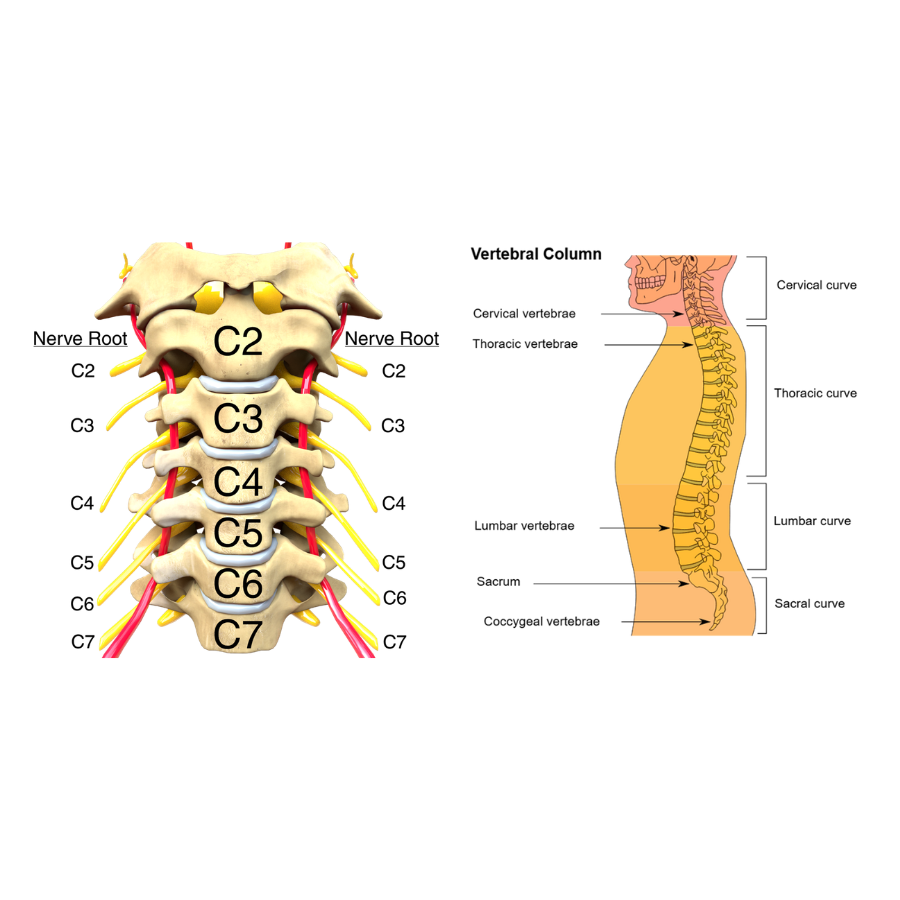
The cervical vertebrae are seven small bones in the neck (C1–C7) that make up the top of the spinal column. The head rests on top of these vertebrae. Their main jobs are to support the head, protect the spinal cord, and allow smooth movement of the neck. These vertebrae are thinner and more mobile than those lower in the spine, which helps the neck bend, rotate, and flex with ease.
C1 (the atlas) is the topmost vertebra. Its job is to hold up the skull, much like the mythical Atlas holding the world.
C2 (the axis), is the second bone in the neck. Its special feature is a tall, tooth shaped structure called the dens. This acts like a pivot. C1, the bone above it sits on top of this pivot. Because of this design, C1 can rotate around C2. This is what allows you to turn your head left and right — like shaking your head “no.”
At the lower end of the neck sits C7, often called the vertebra prominens. It has a long, prominent spinous process that sticks out more than the others, making it the most easily felt bone at the base of the neck - typically the last bump you can feel before reaching the upper back (T1).
Each vertebrae is separated by an intervertebral disc – it is a relatively soft, cushion-like pad, that is flexible enough to allow the spine to move. Inside the spinal column is the spinal cord, a long nerve pathway that runs from the brain to the end of the spinal column. Nerves exit the spinal column on the left and right, between the vertebrae, through holes called the intervertebral foramen. These nerves then connect to the rest of your body. The section of the nerve that is exiting the vertebrae is bulged compared to the rest of the nerve; it is known as the nerve root.
I have 7 cervical vertebrae. Why do I have 8 cervical nerves?
When doctors want to talk about a specific nerve root, they identify it based on the vertebrae directly below it (e.g C1 nerve root comes out just above C1 vertebrae). The exception, C8 nerve root, occurs above T1. The thoracic nerves are named based on the vertebra on top of it (eg T1 nerve is the nerve coming out between T1 and T2)
What do the cervical nerves do?
Nerves carry signals between the brain and the rest of the body. Cervical nerves perform multiple functions, but the main functions we think about are
C3,4,5 – supplies the diaphragm, which allows us to breath (C3, 4, 5 keeps the diaphragm alive)
C5-T1 – supplies the ‘brachial plexus’, a nerve bundle that connects the arms to the spinal cord.
What happens when I have cervical radiculopathy?
A multitude of conditions can cause irritation of the nerve roots, leading to pain issues doctors refer to as cervical radiculopathy. These can be mechanical (directly pressing on the nerve) or inflammatory (irritation around the nerve)
A herniated (ie slipped) intervertebral disc
Narrowing of the intervertebral foramen
Degeneration of the intervertebral discs
Inflammation of the joints (arthritis)
When these nerves get irritated, they can cause a distinct type of pain known as ‘nerve pain’. In some cases, it can causes tingling and numbness in the arms, or make the arms feel weak. This is because nerves provide sensation, but also control the muscles. The pain is sometimes worse when moving the neck (mechanically irritating the nerve root) or with arm movement (which can stretch the brachial plexus).
How do I know I have it? Could it be something else?
Cervical radiculopathy is largely a ‘clinical diagnosis’ – this means that a doctor can diagnose it based on the history, signs and symptoms of the condition. Doctors may ask for extra tests such as MRI or nerve conduction studies if they want to know more about what is happening, or want to check there isn’t another problem that is happening.
There is a wide range of other conditions that can appear similar to cervical radiculopathy. These are caused by different issues and may need to be treated differently.
How do I treat it?
Most people (~80-90%) of people with cervical radiculopathy will have improvements after 8-12 weeks; the important thing is to manage the pain well with a combination of medication and physical rehabilitation. Physical rehabilitation will improve pain but also reduce the chance of the problem coming back. Unfortunately, some people unfortunately have ongoing pain issues after the 12-week mark; in these cases, it’s important to have it investigated. Sometimes, the symptoms are occurring due to other issues, or it may require further interventions.